


CM Culture Displays
The Twelve Meridians
Design Description
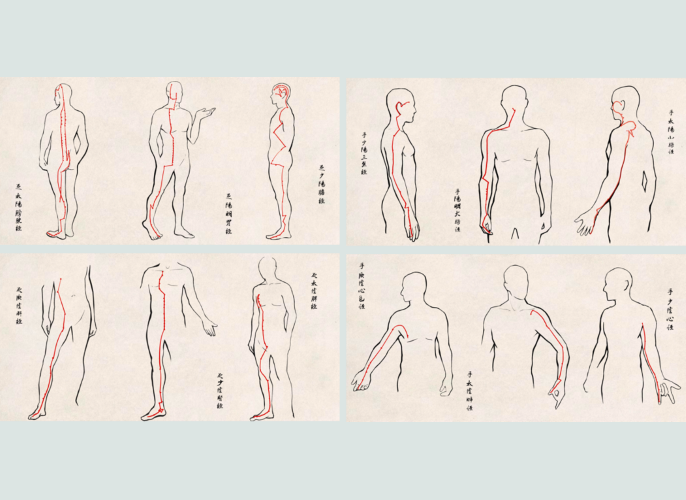
The pictorial design artistically imitates from the jingluo (meridian) diagrams of the twelve regular meridians found in classical texts, displaying their distribution and course and outlining the relationship between the meridians and the zang‑fu organs (viscera and bowels). The twelve regular meridians are the meridians pertaining to the zang‑fu organs of the human body and form the main body of the meridian system.
The names of the twelve meridians are composed of three elements: hand or foot, yin or yang, and zang or fu. They include the three yin meridians of hand (lung meridian of hand‑Taiyin, pericardium meridian of hand‑Jueyin, heart meridian of hand‑Shaoyin), the three yang meridians of hand (large intestine meridian of hand‑Yangming, Sanjiao meridian of hand‑Shaoyang, small intestine meridian of hand‑Taiyang), the three yang meridians of foot (stomach meridian of foot‑Yangming, gallbladder meridian of foot‑Shaoyang, bladder meridian of foot‑Taiyang), and the three yin meridians of foot (spleen meridian of foot‑Taiyin, liver meridian of foot‑Jueyin, kidney meridian of foot‑Shaoyin).
The above translation was supervised by Prof. Janice PAN. The content was translated by Ms. Janet YU, and edited by Prof. Janice PAN and Dr. Robert TSATURYAN, with Mr. Sing Leung CHAN, Chinese Medicine Practitioner, serving as consultant.
