


CM Culture Displays
The Course of History: Jin and Yuan Dynasties
Design Description
“Confucian schools divided in the Song; medical schools divided in the Jin and Yuan”— from Siku Quanshu Zongmu Tiyao (Annotated General Catalogue of the Complete Library of the Four Treasuries).
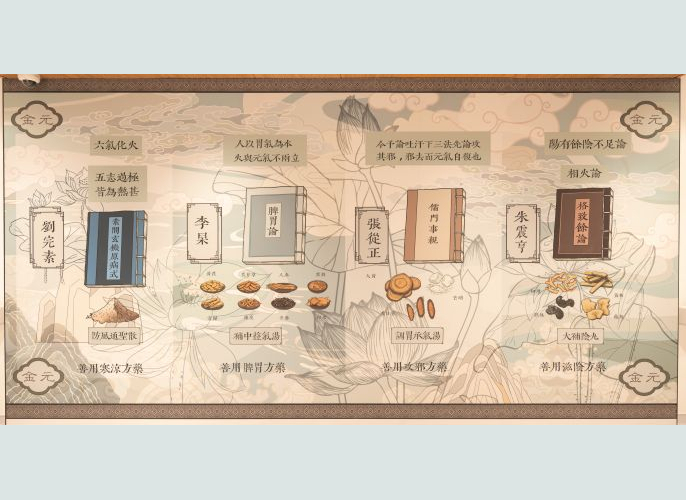
The composition uses river branches as its backdrop, symbolising the origins, evolution, and mutual influence of the Four Great Masters of the Jin and Yuan. The main river represents the development of Chinese medicine classics; the branches present each school’s theoretical characteristics and therapeutic concepts. In particular, Liu Wansu held that different climates and emotions could ultimately transform into huo-re (fire heat) within the body, and excelled at treating with cold and cool formulae. His representative formula is Fangfeng Tongsheng San (Saposhnikoviae Powder to Permeate the Sagely), and he authored Suwen Xuanji Yuan Bing Shi (Analysis of the Profound Mechanisms of Plain Questions and the Origin of Diseases). Li Dongyuan emphasised the spleen and stomach as the root of postnatal life, excelled at spleen-stomach formulae, with Buzhong Yiqi Tang (Decoction to Tonify the Centre and Augment Qi) as his representative formula and Pi Wei Lun (Treatise on the Spleen and Stomach) his representative work. Zhang Congzheng emphasised “gong-xie (attacking and expelling pathogenic factors)” as treatment, inheriting the scholarly thought of his predecessors; his representative formula is Tiaowei Chengqi Tang (Decoction to Regulate the Stomach and Order the Qi) and representative work Rumen Shiqin (Confucian Duties to Parents). Zhu Zhenheng proposed the theory of yang in excess and yin in deficiency, excelled at nourishing yin formulae, with Dabu Yin Wan (Major Yin-Tonifying Bolus) as his representative formula and Ge Zhi Yu Lun (Treatise on Inquiring the Properties of Things) his representative work. Each school is paired with representative medicinal materials and symbolic imagery to strengthen visual recognition and display its distinctive medical perspective. The four masters are like diverging waters: though their directions differ, they ultimately converge into a combined force driving the continuous evolution of Chinese medicine, embodying theoretical diversity and depth of thought.
The above translation was supervised by Prof. Janice PAN. The content was translated by Ms. Emma LAM, and edited by Prof. Janice PAN and Dr. Robert TSATURYAN, with Mr. Sing Leung CHAN, Chinese Medicine Practitioner, serving as consultant.
