


CM Culture Displays
Classical Anecdotes of Traditional Chinese Medicine
Design Description
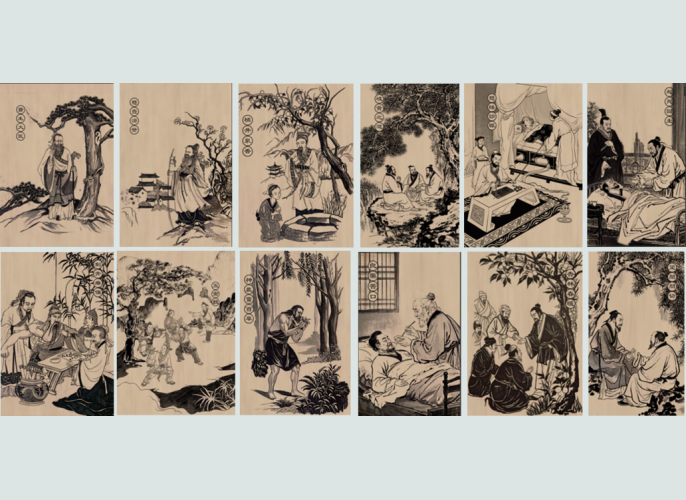
This series comprises twelve illustrated works based on classical anecdotes from ancient Chinese medicine. The illustrations feature figures and landscape scenes as their main subjects, presenting important figures and story settings from the development of Chinese medicine.
Pulse-Taking by a Thread: A Legend of Diagnosis and Decorum
“Pulse-Taking by a Thread” is a legendary story in the history of Chinese medicine, referring to the physician placing one end of a silk thread on the female patient’s wrist whilst holding the other end, and judging the patient’s pulse from the sensations transmitted through the thread to diagnose disease. The origin of this legend was in fact influenced by the ancient notion that “men and women should not touch when handing over objects”. Owing to the strict moral codes of antiquity, male physicians were generally not permitted physical contact with female patients, especially those of royal lineage, hence the emergence of such tales. In practice, when imperial physicians performed mai zhen (pulse examination), they often did so through a layer of gauze, thus avoiding direct contact without compromising diagnostic accuracy.
The Five Animal Frolics: Hua Tuo’s Foundational Qigong Exercises
The Five Animal Frolics first appear in Sanguo Zhi (Records of the Three Kingdoms), in the Biography of Hua Tuo. Tradition holds that this health-preserving exercise was created by the renowned physician Hua Tuo, though the original movements have unfortunately been lost. Yangxing Yanming Lu (Records on Nurturing Nature and Extending Life) is the extant version closest to Hua Tuo’s original Five Animal Frolics. Through imitating and refining the movements of five animals, namely tiger, deer, bear, ape and bird, and combining theories of health preservation including yin-yang, the five elements and meridians and collaterals, Hua Tuo developed a systematic form of exercise with both physical training and health-preserving functions. The Five Animal Frolics aim to regulate qi and blood and the functions of the zang-fu organs, achieving the goals of strengthening the body and preventing disease.
Reviving the Dead: The story of Bian Que and the Comatose Prince
This highly legendary story is found in Shiji (Records of the Grand Historian), in the Bianque Canggong Liezhuan (Biographies of Bian Que and Cang Gong). The text records that Bian Que, whilst travelling to practise medicine, passed through the state of Guo and heard that the crown prince had just died. Learning that the prince had not yet been encoffined, he asked the prince’s attendant to re-examine the prince’s condition. Following Bian Que’s instructions, the attendant discovered that the prince still had body warmth and immediately reported this to the ruler of Guo. In the end, after Bian Que and his disciples applied acupuncture, the prince indeed awoke. From then on, people spread the tale that Bian Que possessed the ability to revive the dead. In truth, however, Bian Que pointed out that it was not that he could bring the dead back to life; rather, the prince had never actually died; he had merely restored him.
Great Physician for the People: The Guiding Ethos of a Master Doctor
Sun Simiao, the great physician for the people, produced the monumental medical work Beiji Qianjin Yaofang (Essential Prescriptions Worth a Thousand in Gold for Emergencies), the first clinical medical encyclopaedia in Chinese history. In the first volume, Sun Simiao set forth the important concept of “Dayi Jingcheng (The Great Physician: Sincerity and Devotion)”, which has been regarded by later generations as the ethical standard for medical practice. Sun Simiao held that those who study medicine should be learned and diligent, tireless in their pursuit. They must moreover possess a heart of compassion, vowing to relieve the suffering of all living beings. All who come seeking help for illness or distress, regardless of rank, wealth, kinship or enmity, Chinese or foreign, wise or foolish, must be treated equally. In treating disease, one must not hesitate out of concern for one’s own fortune or safety. Whatever may occur, one must single-mindedly strive to deliver the patient from suffering; only thus may one become a “great physician for the people”.
Hanging the Gourd to Heal the World: The Enduring Symbol of a Traveling Physician
The mysterious tale of “hanging the gourd to heal the world” is found in Hou Han Shu (Book of the Later Han), in the Fangshu Lielun (Biographies of Fangshu Practitioners): Fei Changfang. Legend has it that during the Eastern Han Dynasty, Fei Changfang of Runan saw an elderly medicine-seller in the market who, each time the market closed, would leap into a gourd hanging in front of his shop. Fei Changfang found this extraordinary and prepared wine and meat to pay his respects to the old man. Knowing his intent, the old man took him into the gourd, where they beheld a magnificent celestial palace filled with fine wine and delicacies. The old man revealed that he was an immortal exiled to the mortal world, and that his term was now complete and he was to return; he asked whether Fei Changfang wished to follow him in seeking the Dao. Over a decade later, Fei Changfang completed his studies and returned. Having gained supernatural powers, he could cure all ailments and whip away a hundred demons. From then on, the “gourd” became a symbol of medical practice, and “hanging the gourd to heal the world” became an honourific for physicians who save people from illness and suffering.
Apricot Forest in Warm Spring: The Symbol of a Compassionate Medical Community
The story of “Apricot Forest in Warm Spring” is found in Chapter Ten on Dong Feng in Shenxian Zhuan (Biographies of Immortals). Dong Feng was a physician who lived in seclusion in the mountains. He treated patients without charging fees, asking only that those who recovered from serious illness plant five apricot trees, and those who recovered from minor illness plant one. After many years, the apricot trees had accumulated into a vast apricot forest. When the apricots ripened, Dong Feng built a granary and told people that if they wanted apricots, they need only exchange an equal amount of grain. When someone tried to exchange a small amount of grain for a large quantity of apricots, or to steal apricots, the tigers attracted to the forest would emerge with roars to drive them away, or even punish the thieves until they returned the apricots and admitted their wrongdoing. The grain thus exchanged was used by Dong Feng to relieve the poor. From then on, “xinglin (apricot forest)” became a symbol of the physician, and physicians often referred to themselves as “those within the apricot forest”.
Scraping Poison off the Bone: The Legendary Surgery of Hua Tuo on Guan Yu
The anecdote of “scraping poison off the bone” originates from the Biography of Guan Yu in the Book of Shu of Sanguo Zhi (Records of the Three Kingdoms). It recounts how Guan Yu was once struck in the left arm by a poisoned arrow. Although the wound later healed, whenever the weather turned damp, his bone would ache severely. A physician said that residual poison remained and that the bone must be scraped to remove it for full recovery. Guan Yu therefore extended his arm for the physician to treat the affected area. It so happened that he was drinking and dining with his generals at the time, and thus Guan Yu completed the process of scraping poison from the bone whilst chatting, laughing and playing weiqi. This story also shaped Guan Yu’s enduring image as the “God of War”. Later, in the narrative of Sanguo Yanyi (Romance of the Three Kingdoms), it was the renowned physician Hua Tuo who performed the treatment on Guan Yu. In reality, however, this could not have been so, for in that story’s timeframe Hua Tuo had already been put to death by Cao Cao. Regrettably, the historical records did not preserve the name of that legendary physician.
The Fragrant Tangerine & Wellspring: The Legend of Su Dan’s Benevolent Healing
“Ju Jing Quan Xiang (The Fragrant Tangerine and Wellspring)” is a traditional Chinese medicine anecdote of mythical colour, as renowned as “apricot grove”. The story originates from Su Xian Gong in Chapter Nine of Shenxian Zhuan (Biographies of Immortals). Legend has it that during the Western Han Dynasty, there was a Daoist named Su Dan, a skilled physician who treated patients without remuneration and was devoted to the arts of health preservation. Before attaining the Dao and becoming an immortal, he foresaw that a plague would sweep the land and instructed his mother to use the well in their courtyard and the tangerine tree beside it to aid those afflicted by the plague, without charging a single coin. The following year, a plague indeed broke out; the people suffered greatly and livelihoods were devastated. Su Dan’s mother steeped tangerine leaves in well water to brew tea, saving countless lives — a deed that became a celebrated tale. Thereafter, people used “Ju Jing Quan Xiang” to extol the healing achievements of physicians, and physicians inscribed it on plaques to declare their purpose.
Shennong Tasting a Hundred Herbs: The Mythical Foundation of Chinese Herbalism
Shennong is revered as the progenitor of Chinese agriculture and medicine. Numerous versions of the legend of Shennong Tasting a Hundred Medicinals circulate, yet at their core lies the same account: moved by compassion, Shennong resolved to taste a wide variety of plants in order to distinguish which were non‑toxic and edible, which could treat disease, and which were poisonous and unsuitable for consumption, thereby teaching the people agriculture and the use of Chinese medicines. It is said that Shennong possessed a peculiar appearance: his body was transparent except for his head and limbs, and his internal organs were clearly visible. When poisonous Chinese medicines entered his body, the affected organs would turn black, enabling him to discern the effects of different medicinal substances upon different parts of the body. In this way, he came to understand their properties and actions. Later accounts vary. Some maintain that Shennong died from ingesting too many poisonous medicinal substances, the accumulated toxicity proving fatal. Others relate that he ultimately perished after consuming Duanchangcao (Gelsemium Elegans or Heartbreak Grass, Herba Gelsemii Elegantis), unable to detoxify in time. In commemoration of his benevolence and his contributions to agriculture and the development of Chinese materia medica, he was honoured with titles such as “King of Pharmaceuticals” and “Great Emperor Shennong”.
The Medical Arts of Qibo and the Yellow Emperor: The Foundational Dialogue of TCM Theory
“Huang” refers to Xuanyuan Huangdi (the Yellow Emperor), and “Qi” to his minister Qibo. Tradition holds that the Yellow Emperor often sat in discourse with Qibo, Leigong and other ministers, discussing medical questions and elucidating the principles of disease causation, diagnosis and treatment through question and answer. This content was recorded in the medical work Huangdi Neijing (Yellow Emperor’s Inner Canon) in dialogue form and has been transmitted to the present day, becoming China’s earliest medical classic. Out of reverence for the Yellow Emperor and Qibo, later generations came to use “the medical arts of Qi and Huang” to denote Chinese medical practice, and to regard Huangdi Neijing (Yellow Emperor’s Inner Canon) as the source of traditional Chinese medicine theory and the most authoritative classic. To this day, all who practise Chinese medicine are expected to have studied Huangdi Neijing (Yellow Emperor’s Inner Canon) thoroughly.
Inspection, Auscultation and Olfaction, Inquiry, Palpation: The Four Secrets of a Master Physician
Wang (inspection), wen (auscultation and olfaction), wen (inquiry) and qie (palpation) are the four methods of diagnosis in traditional Chinese medicine. Inspection is the observation of changes in the patient’s spirit, complexion, physique and bearing, both overall and local, such as facial complexion and tongue coating; auscultation and olfaction involve listening to the voice and smelling odours, for example the patient’s speech, cough and breathing, and body odour; inquiry is asking the patient about the symptoms they experience, to understand the onset, development and course of treatment of the disease, as well as past health; palpation is taking the pulse or touching and pressing parts of the patient’s body with the hands. These are the si zhen, the four diagnostic methods. The diagnostic methods indispensable and should be exercised in combination: through them the physician gathers complete evidence and gains a comprehensive understanding of the patient’s condition.
Good Medicine Tastes Bitter: A Lesson in Truth and Healing
The phrase “liangyao kukou (good medicine tastes bitter)” originates from the chapter Wai Chu Shuo Zuo Shang of Han Fei Zi (The Works of Han Fei): “Good medicine is bitter to the mouth, yet the wise urge one to drink it, knowing that it enters and cures one’s illness. Loyal words grate on the ear, yet the enlightened ruler heeds them, knowing they can bring success.” This philosophical maxim compares sincere admonition to bitter medicine: though both are unpleasant, for the sake of recovery one must drink the bitter medicine and heed the unwelcome advice. In traditional Chinese medicine, “bitter” is one of the five flavours (sour, bitter, sweet, pungent and salty). Bitter has the properties of draining and drying; it can purge, clear heat, drain fire and dry dampness. Therefore, to recover as soon as possible, even if the medicine is bitter, one must take it as prescribed and on time.
The above translation was supervised by Prof. Janice PAN. The content was translated by Ms. Eunice Chan, and edited by Prof. Janice PAN and Dr. Robert TSATURYAN, with Mr. Sing Leung CHAN, Chinese Medicine Practitioner, serving as consultant.
