


CM Culture Displays
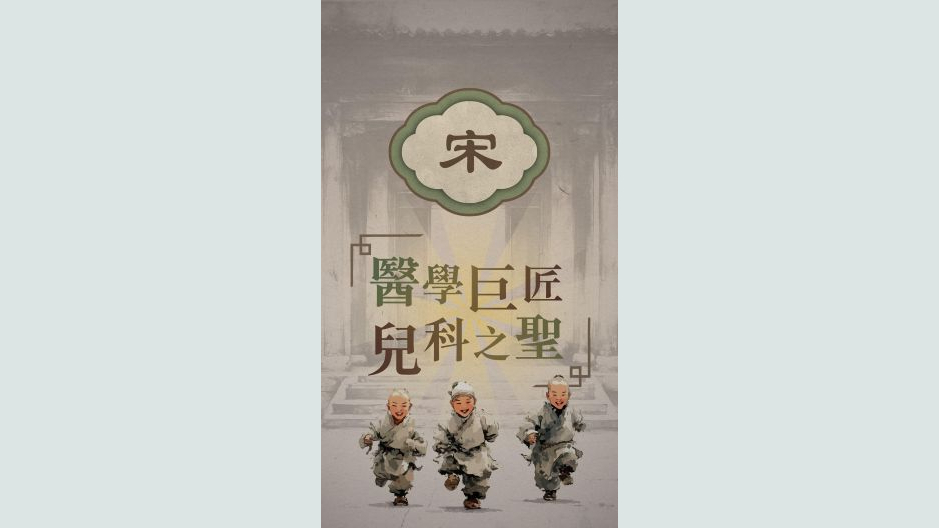
The Medical Sage of Paediatrics in the Song Dynasty
The Song Dynasty stands as a pivotal era in the development of traditional Chinese medicine (TCM) paediatrics. Qian Yi, a renowned paediatric specialist of his time, left behind a legacy of clinical theories and clinical experience that remain instructive and applicable to physicians today.
Qian Yi was granted the prestigious post of Hanlin Yiguan (Imperial Physician) for his meritorious treatment of the Grand Princess. The Hanlin Yiguan Yuan (Imperial Academy of Medicine) was a state office responsible for medical policy and administration, while the Taiyi Ju (Imperial Medical Bureau) managed medical education. This division reflected the Song government’s reform to strengthen medical governance by separating medical administration from medical education.
Like many classical TCM texts, traditional Chinese medicine classics, Xiao’er Yao Zheng Zhi Jue (Key to Therapeutics of Children’s Diseases) was compiled by Qian Yi’s disciples. What makes this text particularly intriguing is its editor Yan Jizhong had originally been Qian Yi’s patient. At the age of six, he was critically ill and was cured by Qian Yi. Thereafter, by a fortuitous circumstance, he gathered Qian Yi’s medical formulas and writings and compiled them into this text.
This book records Qian Yi’s academic thought and summarises his clinical experience in paediatrics, serving as a bridge between earlier foundations and later developments in TCM paediatrics.
In diagnosis, Qian Yi applied the principles of Huangdi Neijing (Yellow Emperor’s Inner Canon) to paediatric practice. By observing variations in colour across different regions of the face and within the eyes, he assessed disorders of the wu zang (five zang organs). He termed these methods mianshang zheng (facial manifestation patterns) and munei zheng (ocular manifestation patterns), reflecting the theory of zang-xiang (visceral manifestation).
Qian Yi was skilled at adapting classical prescriptions to create new formulas. The widely used Liuwei Dihuang Wan (Bolus of Six Medicinals Including Rehmannia) was derived from the Shenqi Wan (Kidney Qi Bolus) recorded in the Eastern Han Dynasty text Jin Gui Yao Lue (Synopsis of Prescriptions of the Golden Cabinet). In accordance with the physiological characteristics of children, he removed the warming medicinals of Guizhi (Cinnamon Twig, Ramulus Cinnamomi) and Fuzi (Prepared Aconite Lateral Root, Radix Aconiti Lateralis Praeparata), thereby formulating a prescription suitable for treating congenital kidney deficiency patterns in children.
Qian Yi’s academic approach placed strong emphasis on pattern identification of the wu zang (five zang organs), namely, differentiating deficiency and excess in the child’s heart, liver, spleen, lung, and kidney in order to determine appropriate prescriptions. He also attached importance to the mutual generating and restricting relationships among the five zang in accordance with the five elements theory.
In the five elements theory, the colour qing (green-blue) corresponds to the wood element, and the liver is also associated with wood. Xieqing Wan (Green-Draining Bolus) was prescribed by Qian Yi to clear and drain liver fire.
The colour chi (red) corresponds to fire, and the heart is likewise associated with fire. Daochi San (Red-Draining Powder) promotes urination through the actions of Mutong (Akebia Stem, Caulis Akebiae) and Zhuye (Bamboo Leaf, Folium Bambusae), thereby guiding heart fire downward to be eliminated via the urine. This formula is used to treat heart heat patterns in children. The Qing Dynasty text Yi Fang Ji Jie (Collected and Analysed Medical Formulas) also records that it is effective in treating symptoms such as facial redness, agitation, mouth and tongue ulcers, teeth grinding, and thirst.
Xiao’er Yao Zheng Zhi Jue (Key to Therapeutics of Children’s Diseases) also documents a specific paediatric condition known as Nongshe (Wagging Tongue). When the spleen is slightly warm, the vessels of the tongue may become mildly tense, causing the child to protrude and move the tongue frequently. The text cautions that this does not indicate intense heat and that excessively cold medicinals should not be used. Instead, Xiehuang San (Yellow-Draining Powder) should be administered slowly and in small doses. The colour huang (yellow) corresponds to earth, and the spleen is likewise associated with earth. Later generations have applied this formula to treat latent spleen-stomach fire patterns.
The colour bai (white) corresponds to metal, and the lung is associated with metal. Xiebai San (White-Draining Powder) is an effective formula for draining lung heat and is used to treat paediatric wheezing and cough.
Taken as a whole, the book contains approximately 140 formulae, the majority of which are prepared as boluses, powders, and ointments. These prepared forms could be made in advance for timely use in response to rapid changes in a child’s condition and were more readily accepted by children. The text also records Yutifa (Medicated Bathing Method), in which infants are bathed in medicinal decoctions to treat paediatric conditions such as Taifei (Fetal Fat), Taire (Fetal Heat), and Taiqie (Fetal Debility). To this day, medicated bathing remains a therapeutic option for conditions such as paediatric exogenous fever and infantile eczema, providing treatment without the need for oral administration of medicinals.
The above translation was supervised by Prof. Janice PAN. The content was translated by Mr. Eden LAW, and edited by Prof. Janice PAN and Dr. Robert TSATURYAN, with Mr. Sing Leung CHAN, Chinese Medicine Practitioner, serving as consultant.
