


CM Culture Displays
Five Grains and Five Fruits
Design Description
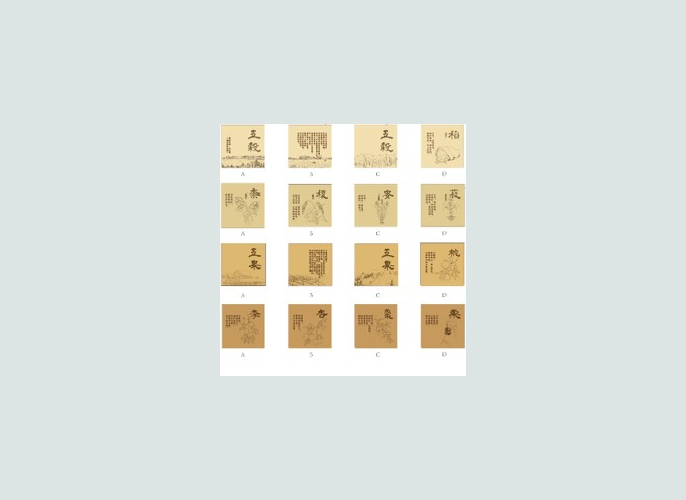
The growth cycle of the wu gu (five grains) is closely linked to seasonal changes; from sowing to harvest, each stage corresponds to the solar terms. Farming sayings such as “around Grain Rain, sow melons and beans” illustrate how solar terms guide agricultural production and form a farming rhythm centred on the cultivation of the five grains.
Dao (rice): A general term for jing mi (non‑glutinous rice) and nuo mi (glutinous rice).
It tonifies the middle and benefits qi, and warms the spleen and stomach. However, nuo mi (glutinous rice) is sticky and difficult to transform; excessive consumption obstructs spleen transport and transformation and results in accumulation and stagnation.
Shu (yellow millet): That is, huang mi (yellow millet). It tonifies the middle and benefits lung qi. Prolonged consumption may cause excessive sleepiness and generate fan re (vexing heat).
Ji (foxtail millet): It benefits qi. When prepared as cooked grain, it supplements deficiency, calms the middle, benefits the stomach, and is suitable for the spleen.
Mai (wheat): That is, xiao mai (wheat). It nourishes heart qi, eliminates ke re (guest heat), relieves vexation and thirst, promotes urination, and nourishes liver qi.
Shu (legumes): Legumes, including da dou (soybean). Consuming da dou (soybean) promotes the growth of muscles and skin, improves complexion, and fills the bone marrow. Excessive consumption may cause heaviness of the body.
Traditional Chinese medicine theory holds that the wu guo (the five fruits) possess different properties, flavours, and therapeutic effects and can work in concert with the wu gu (five grains), wu chu (five domestic animals), and the like to balance the diet and nourish the body. For example, zao (jujube) can tonify the spleen and benefit the stomach; xing (apricot) can quench thirst and promote fluid production. Appropriate consumption supports the maintenance of yin‑yang balance and the harmonious coordination of zang‑fu (viscera and bowels) functions.
Tao (peach): The fruit of the lung. Excessive consumption may generate heat. Tao ren (peach kernel) treats blood binding, moistens the intestines, and promotes bowel movement.
Li (plum): The fruit of the liver. It regulates the middle. Excessive consumption may generate xu re (vacuity heat). The kernel treats lower abdominal swelling and fullness in women.
Xing (apricot): The fruit of the heart. Slightly toxic when eaten raw. Excessive consumption may generate tan re (phlegm‑heat). It relieves thirst and promotes fluid production.
Zao (jujube): The fruit of the spleen. It nourishes the spleen and harmonises the stomach, tonifies qi and nourishes fluids, and harmonises various medicinals. Excessive consumption may damage pi yuan (spleen origin) and promote shi re (dampness‑heat).
Li (chestnut): The fruit of the kidney. It tonifies the kidney and benefits qi, strengthens the intestines and stomach, enhances resistance to hunger, and treats impairment of the lumbar region and legs.
The above translation was supervised by Prof. Janice PAN. The content was translated by Mr. Adrian MOK, and edited by Prof. Janice PAN and Dr. Robert TSATURYAN, with Mr. Sing Leung CHAN, Chinese Medicine Practitioner, serving as consultant.
