


CM Culture Displays
Paediatric Diagnostic Methods in Chinese Medicine
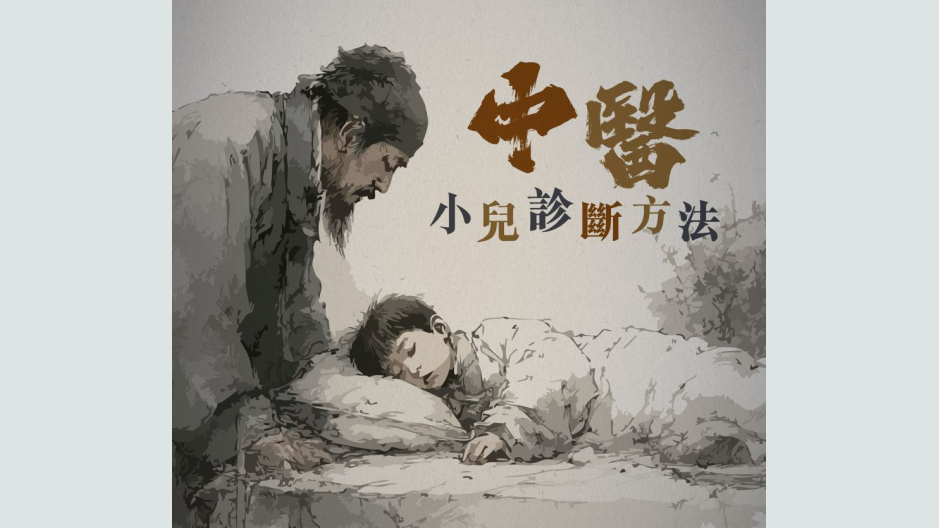
Through the four diagnostic methods of wang (inspection), wen (auscultation and olfaction), wen (inquiry), and qie (palpation), the traditional Chinese medicine (TCM) practitioner diagnoses a child’s condition according to the holistic principle and provides treatment based on pattern identification.
Inspection: When observing a child, in addition to general observations of the spirit, facial complexion, eye expression, and tongue manifestations, the inspection of superficial veins on the index finger is a diagnostic method unique to TCM paediatrics. The superficial veins on the radial side of a child’s index finger are visible because an infant’s skin is thin and delicate, allowing the collaterals to be easily seen. For children under the age of three, finger vein inspection is often used as part of the diagnostic process. Liu Fang of the Song Dynasty recorded in Youyou Xinshu (New Book for Children’s Health): “The finger veins are divided into three barriers, running from the hu kou (purlice) towards the fingertip”. This refers to the superficial veins on the radial side of the index finger, which are divided into three segments from the base of the index finger to the fingertip: feng guan (wind pass, closest to the purlice), qi guan (qi pass, the middle segment), and ming guan (life pass, closest to the fingertip). By observing the degree of visibility, colour, and form of the veins on the child’s index finger, one can identify the location and nature of the disease, as well as its severity and prognosis.
Auscultation and Olfaction: Listening to the child’s crying, breathing sounds, coughing, and speech, as well as noting the odour of the breath, urine and faeces, nasal discharge, saliva, and perspiration — all can assist in understanding the child’s condition.
Inquiry: “First ask about cold and heat, second about sweating; third about the head and body, fourth about bowel habits; fifth about diet, sixth about the chest and abdomen; seventh about deafness, eighth about thirst — all must be discerned; ninth, ask about prior illnesses, and tenth about the cause.” The Ten Questions Song in TCM contains the essential information a practitioner needs to gather. However, since young children generally lack awareness of their own condition or have not yet fully developed their cognitive abilities, parents should observe on their behalf to assist in answering these questions.
Palpation: In addition to pulse diagnosis, TCM practitioners may also perform palpation of the head to examine the fontanelle, palpate the left anterior chest at the apex of the heart to assess the condition of zong qi (ancestral qi), examine the temperature and tone of the limbs, and assess the skin for perspiration.
Emotional Observation: TCM holds that excessive qi qing (seven emotions) — joy, anger, sorrow, overthinking, worry, fear, and fright — are related to disease. Therefore, observing a child’s emotional state is of particular importance. Changes in the child’s temperament, behavioural patterns, interactions with parents, and responses to the surrounding environment must not be overlooked.
Holistic Assessment: All the above information is integrated to form a comprehensive assessment of the child’s current health status, thereby determining the cause of illness and formulating treatment recommendations.
TCM diagnosis of children places great emphasis on individual differences. Even with similar symptoms, different children may have different causes and require different treatments. The approach emphasises bianzheng shizhi (pattern identification and treatment identification), striving for precision.
The above translation was supervised by Prof. Janice PAN. The content was translated by Ms. Emily SIU, and edited by Prof. Janice PAN and Dr. Robert TSATURYAN, with Mr. Sing Leung CHAN, Chinese Medicine Practitioner, serving as consultant.
