


CM Culture Displays
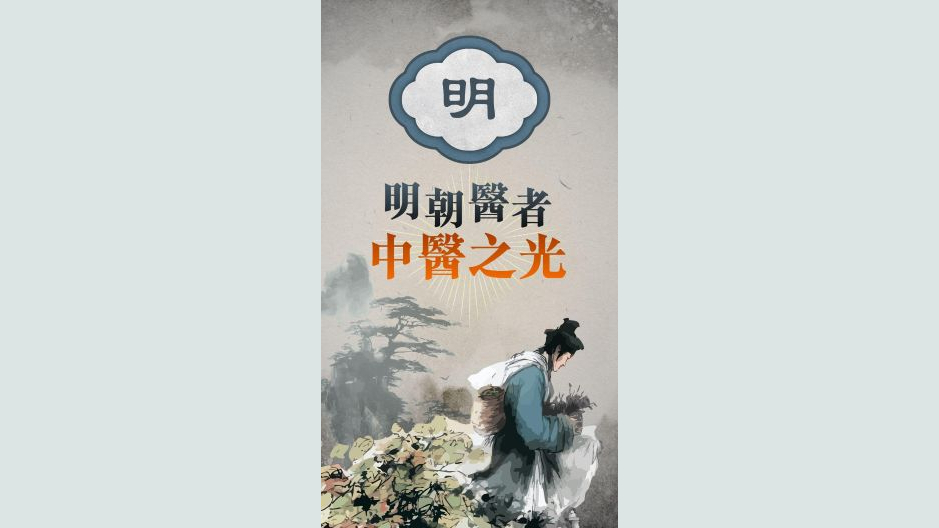
The Luminaries of Traditional Chinese Medicine in the Ming Dynasty
When Li Shizhen compiled the Ben Cao Gang Mu (Compendium of Materia Medica), he discovered that earlier materia medica texts were often confused in their nomenclature, vague in describing the morphology and properties of medicinal substances, and largely copied from previous works without adequate field verification. Determined to rectify these shortcomings, he personally undertook empirical investigation. Accompanied by his disciple Pang Xian and his son Li Jianyuan, he travelled extensively through mountains and forests, collecting specimens and observing their natural habitats. He also widely consulted renowned physicians and learned scholars, and even sought advice from farmers and fishermen regarding folk remedies. Moreover, he personally tested medicinals to record their effects. As a result of this rigorous empirical approach, the book contains 1,109 illustrations of medicinal substances, depicting their morphological characteristics in detail.
Zhang Jingyue was renowned for his extensive use of Shudihuang (Prepared Rehmannia Root, Radix Rehmanniae Praeparata) and was therefore affectionately nicknamed Zhang Shudi. Shudihuang is one of the commonly used warming and tonifying medicinals in traditional Chinese medicine (TCM). In Jingyue Quanshu (Complete Works of Jingyue), Zhang proposed that Renshen (Ginseng Root, Radix Ginseng), Shudihuang (Prepared Rehmannia Root, Radix Rehmanniae Praeparata), Fuzi (Prepared Aconite Lateral Root, Radix Aconiti Lateralis Praeparata), and Dahuang (Rhubarb Root and Rhizome, Radix et Rhizoma Rhei) constitute the si wei (four pillars) among medicinals, emphasising their importance. He wrote: “Renshen and shudihuang are worthy ministers in times of peace; fuzi and dahuang are valiant generals in times of disorder. Generals are not to be used for long, hence their use is temporary; yet disorder must not be neglected, so worthy ministers are indispensable.” These four medicinals are often characterised as follows: renshen ranks first in tonifying qi; shudihuang ranks first in nourishing; fuzi ranks first in warming yang; dahuang ranks first in purgation. In his middle and later years, Zhang devoted most of his time to clinical practice and writing. Jingyue Quanshu (Complete Works of Jingyue) comprises nearly one million Chinese characters and was written alongside his daily clinical work, over a period of twenty years until his death. Legend has it that Zhang Jingyue was so devoted to his practice that he travelled extensively to treat patients by day and wrote by lamplight at night.
Wu Youxing, styled Youke, later commonly known as Wu Youke, authored Wenyi Lun (Treatise on Pestilence). He argued that the pathogenic factor responsible for warm epidemics was not wind, cold, summerheat, or dampness, but a distinct pathogenic qi known as liqi (pestilential qi), which invades through the mouth and nose and lies latent in the moyuan (pleurodiaphragmatic interspace). Based on this theory, he devised the formula Dayuan Yin (Decoction to Reach the Membrane Source), composed of Binglang (Areca Nut, Semen Arecae), Houpo (Magnolia Bark, Cortex Magnoliae Officinalis), Caoguo (Tsaoko Cardamom Fruit, Fructus Tsaoko), and Zhimu (Anemarrhena Rhizome, Rhizoma Anemarrhenae), among others, to expel pathogenic factors hidden in the moyuan, enabling the pathogen to disintegrate and swiftly leave that region. Dayuan Yin was later widely applied in the treatment of malaria and epidemic diseases, becoming representative of his medical thought. Wu Youke broke through the traditional view that “external pathogens must enter through the skin and body hair”, proposing instead that epidemic diseases possess strong transmissibility and may selectively invade particular populations or organs. His theoretical orientation reflected a “one disease, one medicinal” approach, which bears conceptual resemblance to the modern search for specific therapeutic agents.
Yang Jizhou achieved renown through his Zhenjiu Dacheng (Great Compendium of Acupuncture and Moxibustion). Building upon his family’s secret manual Zhenjiu Xuanji Miyao (Secret Essentials of the Profound Mechanisms of Acupuncture and Moxibustion), he extensively consulted more than twenty earlier acupuncture classics and integrated his own clinical experience to compile this work. The book systematically records acupuncture theory and operational standards, standardises the nomenclature and locations of shuxue (acupoints), and includes the “Tongren Mingtang Tu (Illustrations of the Illuminated Hall on the Bronze Figure)”, rendering acupuncture knowledge more visual, systematic, and complete. It became an authoritative text for later generations studying acupuncture.
Zheng He’s seven voyages to the Western Seas not only expanded the Maritime Silk Road but also promoted exchanges of civilisation and technical knowledge. His fleet was accompanied by medical officers and medicinal supplies, ensuring the health of the crew during long voyages. At the same time, Chinese medical knowledge and medicinal substances were introduced to the countries along the maritime routes. This transmission of medical and cultural knowledge, intertwined with commercial exchange, enabled regions of Southeast Asia not only to engage in trade but also gradually to encounter and absorb Chinese medical theories and therapeutic methods.
The above translation was supervised by Prof. Janice PAN. The content was translated by Ms. May NG, and edited by Prof. Janice PAN and Dr. Robert TSATURYAN, with Mr. Sing Leung CHAN, Chinese Medicine Practitioner, serving as consultant.
